 how-to
How to Use Gua Sha for Facial Tension: A Step-by-Step Guide
Table of Contents
- What You'll Need Before You Start
- Step-by-Step Gua Sha Technique for Facial Tension
- Gua Sha Pressure Guide: Light vs. Medium Pressure
- Gua Sha Jaw Tension Relief: Targeting the Masseter and TMJ
- Best Facial Oil for Gua Sha: What to Look For
- How Long to Gua Sha Face for Tension Relief
- Common Mistakes and How to Troubleshoot Them
- Conclusion
- Frequently Asked Questions
Last Updated: September 30, 2026
What You'll Need Before You Start
Learning how to use gua sha for facial tension starts with the right setup: a jade stone, a slip agent, and clean hands. Most people quit in week one because they scrape dry skin with a cold tool and decide it hurts.
Here is what to gather before your first stroke:
- A gua sha tool with a smooth, polished edge
- A facial oil or serum for slip
- A clean towel and warm water
- Two minutes of quiet, ideally in front of a mirror
Step-by-Step Gua Sha Technique for Facial Tension
The full routine takes about five minutes: prep your skin, work the neck first, then the jaw, cheeks, and brow. Always move outward and upward, one stroke at a time.
Preparing Your Skin and Tool
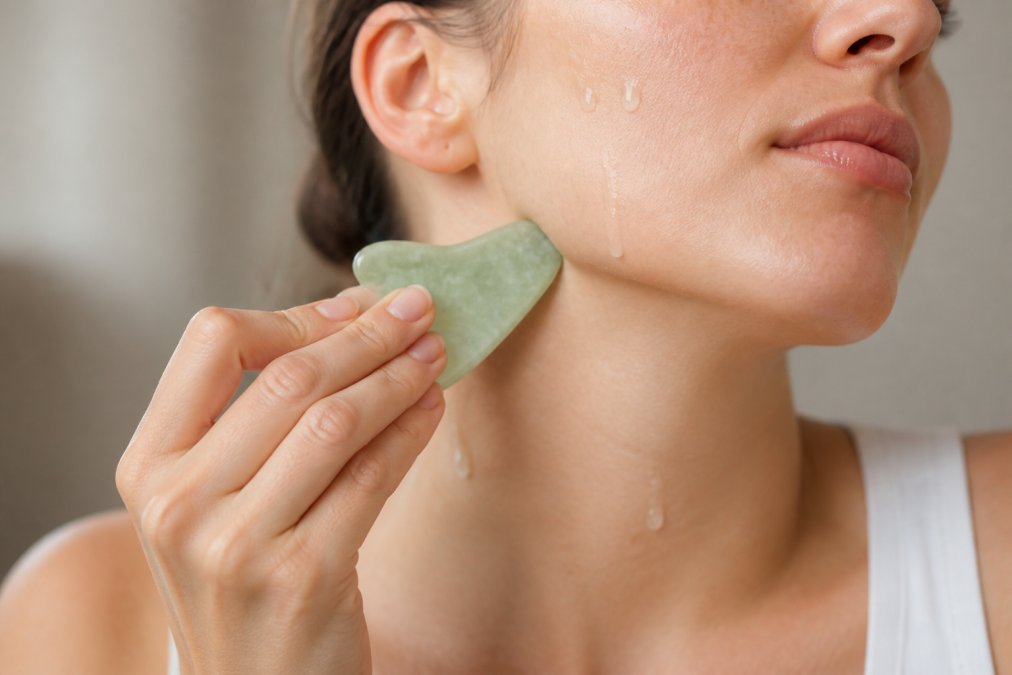
Wash and pat your face dry, then press in a few drops of facial oil warmed between your palms. The surface should feel slick, never tacky. Clean your stone with warm water and mild soap before and after each use, a dirty tool drags on the skin barrier and causes redness.
The Core Strokes: Neck, Jaw, and Cheeks
Start at the neck, since tension there pulls down on the whole face. Hold the stone flat and glide upward from collarbone to jaw with light pressure, three to five times per side. Move to the jaw: notched edge under your chin, sweeping along the bone toward your ear. Then the flat edge on your cheeks, nose toward temple, and finish with the brow, inner corner outward.
Gua Sha Pressure Guide: Light vs. Medium Pressure
Light pressure is the default for the face; medium pressure belongs on the neck and jaw, where muscles sit deeper. Most beginners press too hard and treat the tool like a scraper. It isn't one.
Signs you're pressing too hard:
- The skin turns bright red within seconds
- You feel a burning or stinging sensation
- The stone skips instead of gliding
- You wake up with marks the next day
Gua Sha Jaw Tension Relief: Targeting the Masseter and TMJ
Jaw tension rarely lives in one muscle. It clusters in a small group that pulls on itself, which is why rubbing the jaw alone often fails. Mapping those muscles before you touch the stone is the difference between a pleasant glide and actual release.
The Tension Map: Five Muscles That Hold Jaw and Facial Tightness
| Muscle | Where It Sits | How It Feels When Tight | Gua Sha Approach |
|---|---|---|---|
| Masseter | Back corner of the jaw, just below the cheekbone | A hard bulge when you clench; sore to press | Notched edge, chin-to-ear, medium pressure, pause at the bulge |
| Temporalis | Fan-shaped, above and beside the temple | Dull headache near the temple; tender to touch | Flat edge, small upward sweeps from the temple toward the hairline, light pressure |
| Medial and lateral pterygoids | Deep inside the jaw, behind the cheekbone | Hard to reach; shows up as a locked or clicking jaw | Not directly scraped, addressed indirectly by releasing the masseter and temporalis first |
| Frontalis | Forehead, above the brows | Horizontal tightness; brow feels heavy | Flat edge, center of forehead outward toward the temple, light pressure |
| Sternocleidomastoid (SCM) | Side of the neck, from behind the ear to the collarbone | Neck stiffness; pulling sensation at the jaw | Flat edge, upward from the collarbone to the jaw, medium pressure |
Finding the Masseter by Landmark, Not by Guess
Place two fingers just in front of your earlobe and clench your teeth, the ridge that rises is the masseter, your target for the next three strokes. For the temporalis, press fingertips flat on your temple and clench again; you'll feel a faint fan-shaped contraction above the cheekbone, where tension headaches often start.
A Sequenced Jaw Routine (About 90 Seconds Per Side)
- Neck first. Flat edge, collarbone to jaw, three passes per side. This clears the drainage path before you work the face.
- Masseter. Notched edge hooked just under the jawbone. Glide chin to ear, medium pressure. Pause two seconds at the bulge. Repeat four times.
- Temporalis. Flat edge at the temple. Small upward sweeps toward the hairline, light pressure. Six to eight short strokes.
- Forehead finish. Flat edge at the center of the forehead, sweeping outward toward each temple. Three passes.
- Drain. Flat edge down the side of the neck toward the collarbone. Two passes.
Keep the sequence slow. Speed is the most common reason people feel nothing after a session.
When It Is TMJ, Not Just Muscle Tension
Gua sha eases muscle tightness; it does not treat joint disorders. Muscle tension feels like a dull ache, a heavy jaw in the morning, or soreness when you press the masseter. TMJ disorders present differently: a click or pop when you open your mouth, pain radiating into the ear, limited opening, or a bite that feels off.
- A click that comes with pain, not just noise
- Jaw locking open or closed
- Pain that worsens over several sessions instead of easing
- Numbness or tingling in the face or jaw
Post-Session Recovery for the Jaw
What you do in the ten minutes after a jaw session shapes how much of the release holds.
- Hydrate. Drink a full glass of water; lymphatic movement depends on fluid.
- Skip the ice. Cold tightens muscle. Use an ice roller on cheeks and under-eyes, not the masseter you just released.
- Avoid clenching triggers. Gum, hard candy, and one-sided chewing re-engage the masseter within minutes.
- Check your sleep position. Stomach sleeping rotates the neck and loads one side of the jaw; back or side sleeping with a supportive pillow keeps the work you just did.
- Wait on actives. Give retinoids and exfoliating acids at least an hour, or use them another night. Freshly scraped skin absorbs more aggressively and stings more.
Best Facial Oil for Gua Sha: What to Look For
The best facial oil for gua sha gives enough glide to last a full routine without clogging pores. Look for lightweight plant oils like rosehip, jojoba, or squalane, and skip added fragrance if your skin is sensitive.
What matters most:
- Slip: the stone should float, not drag
- Short ingredient list: fewer additives means less irritation risk
- Fast absorption: you shouldn't feel greasy an hour later
- Your skin type: dry skin handles richer oils; oily skin does better with light ones
How Long to Gua Sha Face for Tension Relief
Five minutes per session is the sweet spot for most people. Longer sessions don't add benefit and raise the odds of irritation.
Gua Sha Massage Tools & Rosehip Oil In →
A simple schedule:
| Frequency | Session Length | Best Time | Main Goal |
|---|---|---|---|
| Daily | 3-5 minutes | Morning | Reduce puffiness |
| 3-4x per week | 5-8 minutes | Evening | Release jaw tension |
| As needed | 2-3 minutes | After work | Quick reset |
Common Mistakes and How to Troubleshoot Them
The biggest mistake is scraping dry skin, which causes redness and micro-irritation instead of muscle release. Every other problem traces back to pressure, speed, or direction.
The Troubleshooting Table
| Problem | Likely Cause | Immediate Fix | Recovery Window |
|---|---|---|---|
| Skin turns red fast | Too much pressure | Ease off to light pressure | Redness that fades in 20 minutes is normal. |
| Stone drags or skips | Not enough oil | Add a few more drops | Re-oil mid-routine if the stone starts to catch |
| No tension relief | Strokes too fast | Slow down, hold at tight spots | Give it two weeks of steady practice before judging results |
| Breakouts after use | Dirty tool or heavy oil | Sanitize the stone, switch oils | If breakouts persist past a week, stop and reassess your oil |
| Jaw feels sorer | Working the muscle too long | Cut to 2 minutes on the jaw | Soreness should ease within 48 hours. |
| Bruising or petechiae | Pressure too high or blood thinners | Stop the session | Bruises fade in 5-10 days. |
| Faintness or dizziness | Working the neck too aggressively | Stop, sit down, hydrate | Avoid neck strokes for 24 hours |
Mistake 1: Pressing Hard Enough to Bruise
Gua sha is not a deep-tissue massage. On the face, the goal is to move the skin and fluid beneath it, not grind the muscle. Bruising, small red or purple dots called petechiae, means capillaries have broken (Bleeding into the skin: MedlinePlus Medical Encyclopedia).
Mistake 2: Skipping the Neck
The neck is the drainage path for everything above it. Always start at the collarbone and work upward, two or three passes per side.
Mistake 3: Using the Wrong Slip Agent
Oil is not optional. A dry stone drags, and dragging causes redness. But the wrong oil causes its own problems.
- Too heavy: coconut oil and thick balms can clog pores on acne-prone skin.
- Too light: watery serums absorb before the routine ends, leaving the stone to skip.
- Fragranced: added fragrance commonly triggers redness and irritation on freshly scraped skin.
Mistake 4: Scraping Over Irritated or Compromised Skin
Gua sha is a mechanical exfoliation of sorts. On healthy skin that's fine; on sunburned, broken, or active breakout skin, it spreads irritation and can push bacteria deeper.
Skip gua sha entirely on:
- Sunburned or windburned skin
- Active cold sores or open blemishes
- Skin recovering from a chemical peel or laser treatment
- Areas with injectables or fillers until your provider clears you
Mistake 5: Treating It as a One-Time Fix
Facial tension is a pattern, not an event. The people who see the biggest change pair gua sha with small daily adjustments: unclenching when they notice it, taking screen breaks, and skipping gum.
When to Stop and See a Professional
Gua sha is a self-care tool, not a treatment for a medical condition. See a doctor, dentist, or physical therapist if you notice:
- Pain that gets worse with each session
- Numbness, tingling, or weakness in the face
- Swelling that does not go down
- A jaw that locks, clicks painfully, or will not open fully
- Bruising that appears without pressure
Conclusion
Facial tension builds quietly: a tight jaw, a dull ache near the ears, a face that feels heavier than it should. Five minutes with a smooth stone and a good oil changes that, for less than a spa visit.
Frequently Asked Questions
How often should you use gua sha for facial tension?
You can use gua sha daily for facial tension, but start with 3-4 times per week to let your skin adjust. Each session should last 5-10 minutes. If you notice redness or sensitivity, reduce frequency to every other day. Consistent, gentle practice works better than aggressive daily scraping, especially if you're targeting jaw tension or TMJ relief.
Can gua sha help with TMJ and jaw clenching?
Gua sha can help ease jaw tension by targeting the masseter muscle, which often tightens from clenching or TMJ. Use the notched edge of your tool to glide along the jawline with light to medium pressure. Avoid pressing directly on the TMJ joint itself. For chronic TMJ pain, pair gua sha with other treatments and consult a healthcare provider.
What oil should I use with a gua sha tool?
The best facial oil for gua sha is one that provides enough slip without clogging pores. Rosehip oil, jojoba, or a lightweight blend work well. Apply 3-5 drops after cleansing. Oils with added vitamin E or aloe vera can also soothe skin. Always patch-test new oils first, especially if you have sensitive skin or a compromised skin barrier.
How do you know if you are using the right pressure for facial tension?
The right pressure feels like a firm but comfortable glide, never sharp pain. Start with light pressure and increase gradually. If your skin turns bright red or you feel tenderness, you're pressing too hard. For facial tension, medium pressure on the jaw and neck is usually enough. Always use upward strokes and keep the tool at a 30- to 45-degree angle.