 how-to
How to Return Damaged Beauty Products: A Step-by-Step Guide
Table of Contents
- Why Retailers Make Damaged Beauty Product Returns Different
- Step 1: How to Document Damaged Shipments for Refunds
- Step 2: Check the Time Limits for Cosmetic Returns
- Step 3: Contact Customer Service and Prep Your Return
- Understanding Refund vs. Replacement Options
- What to Do If the Retailer Denies Your Claim
- A Simple Beauty Product Return Policy Template for Your Records
- Conclusion: Your Path to Returning Damaged Beauty Products
- Frequently Asked Questions
Last Updated: September 5, 2026
Receiving a smashed foundation palette or a leaking serum is one of the most frustrating parts of online shopping. Learning how to return damaged beauty products doesn't have to be a battle, though. At Green Vitality USA, we handle enough shipments to know that damage happens, and a clear, calm process gets you a refund or replacement faster than frustration ever will.
Below, we'll walk you through the exact steps to document the damage, check your return window, and secure a resolution, including what to do when a retailer hesitates. We'll also give you a simple policy template to track your claims.
Why Retailers Make Damaged Beauty Product Returns Different
Beauty products get extra scrutiny during the returns process for one main reason: hygiene standards. A retailer cannot resell an opened or compromised cosmetic, so they are naturally cautious about fraud and contamination. This means the burden of proof sits with you.
Most retailers require photographic evidence before they will process a claim for return damaged beauty products. Unlike a shirt that doesn't fit, a damaged cosmetic can't be restocked. The retailer needs to verify the product was defective or broken in transit, not used and returned.
Step 1: How to Document Damaged Shipments for Refunds
Documenting the damage correctly is the single most important step in the process. You need to establish a clear chain of evidence that proves the product arrived in this condition.
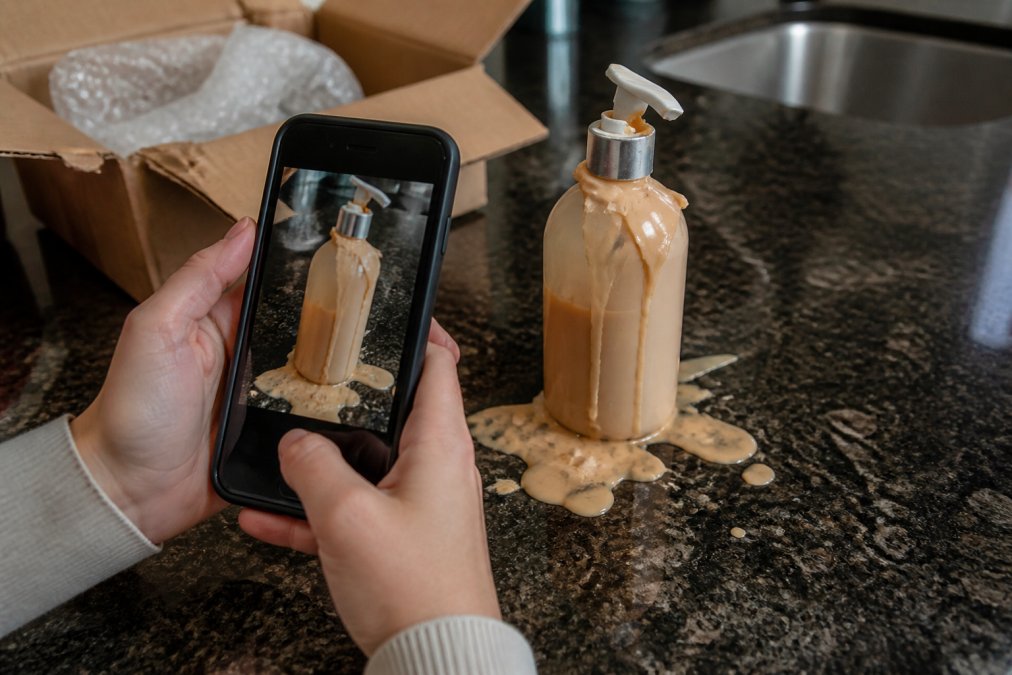
Start by taking photos before you touch anything else. Follow this sequence for the best results:
- Photograph the shipping box with the label visible, showing the delivery date.
- Capture the packaging inside, including any padding or lack thereof.
- Photograph the product itself, showing the damage clearly, such as a smashed compact or leaking pump.
- Take a close-up shot of the batch code or serial number on the product if visible.
- Keep the box and all packing materials until the claim is resolved.
A common mistake is throwing away the shipping box before contacting customer service. Retailers often ask for photos of the box to assess how the carrier handled the shipment. Without the box, your claim loses credibility. Send these photos to customer service immediately.
Step 2: Check the Time Limits for Cosmetic Returns
Time is not on your side when a package arrives damaged. Most retailers enforce a strict return window that begins the day your package is delivered, not the day you open it. For cosmetics, this period is often shorter than for other goods.
The standard time limits for cosmetic returns typically range from 14 to 60 days after delivery (the FTC). You should check the policy on the order confirmation email or the retailer's website to find the exact deadline. If you are outside this window, many retailers will still offer a goodwill gesture, but they are not obligated to do so.
To protect yourself, open and inspect your order within the first few days of delivery. A delayed inspection is the most common reason claims are denied. If you know you will be away, consider having the package held or delivered to a neighbor who can check it promptly.
Step 3: Contact Customer Service and Prep Your Return
Once your documentation is ready, contact customer service through the retailer's official channel. Email is often best for damage claims because you can attach photos and keep a written record of the conversation.
Before you reach out, gather your order number, the photos you took, and your proof of purchase. A clear subject line like "Damaged on Arrival - Order #12345" helps the agent route your request correctly. Explain that the return damaged beauty products process is needed because the item arrived broken or defective.
The retailer will likely offer one of two resolutions: a prepaid shipping label to return the item, or an immediate replacement. For cosmetics that are broken or leaking, many companies will not ask for the item back. If they do request a return, keep the product in its original packaging and follow their instructions.
Understanding Refund vs. Replacement Options
The choice between a refund and a replacement depends on your needs, the product's availability, and the retailer's specific policy. While the table below shows the general framework, the real-world application varies by company.
| Option | Best For | Timeline | What You Need |
|---|---|---|---|
| Full Refund | Out-of-stock items, repeated issues | 3-10 business days after approval | Proof of purchase, damage photos |
| Replacement | Items you still want | Ships within 1-3 business days | Same as refund, often no return needed |
| Store Credit | Quick resolution, future purchases | Immediate upon approval | Same as refund |
The Partial Refund Reality
A common pattern among large retailers is offering a partial refund when a product is damaged but still partially usable. For example, if a pressed powder compact arrives with one corner shattered but 80% of the product is intact, a retailer might offer a 30-50% refund rather than a full one. This is not an obligation; it is a goodwill gesture. You are not required to accept it if the product is genuinely compromised.
The 'No Return Needed' Policy
Many direct-to-consumer beauty brands have adopted a 'no return needed' policy for damaged items under a certain dollar threshold. After you send photos proving the damage, they will issue a refund or send a replacement without requiring you to ship the broken product back. If a retailer does not offer this upfront, ask if they have a 'destroy in place' option.
The Return Shipping Label Nuance
If a retailer does require the item back, they must provide a prepaid return shipping label. Under most state consumer protection laws and the FTC's Mail Order Rule, the seller bears the cost of return shipping when the item arrived damaged or defective (the FTC). If a retailer asks you to pay for return shipping on a damaged item, that is a red flag.
When a Replacement Is Not Available
If the product you ordered is discontinued or out of stock, a replacement is not an option. In this case, you are entitled to a full refund to your original payment method. Some retailers will try to steer you toward store credit. If you prefer a refund, you can insist on it, citing the retailer's own policy on damaged goods. The Fair Credit Billing Act also supports your right to a refund for goods that were not delivered in the condition promised (consumer.ftc.gov).
What to Do If the Retailer Denies Your Claim
Even with perfect documentation, a retailer may deny your claim. This happens most often when they suspect the damage occurred after delivery or when the product shows signs of heavy use. If this happens, do not accept the denial as final. Here is a structured escalation path.
Step 1: The Supervisor Review
Your first escalation path is to reply to the denial email and ask for a supervisor review. Restate the facts calmly and reference your photos. A supervisor typically has more authority to approve exceptions than the initial agent. Here is a template you can adapt:
Subject: Escalation Request - Damaged Order #12345
Dear [Retailer Name] Customer Service Team,
I am writing to request a supervisor review of my claim regarding order #12345, which arrived on [date]. The product was damaged in transit, as evidenced by the attached photos showing the broken pump and leaking serum. I have followed your return policy guidelines and reported this within the specified window.
I am requesting a full refund or replacement, as the product is unusable and cannot be resold due to hygiene concerns. I would also like to avoid the unnecessary waste of shipping a damaged, leaking product back, which would require additional packaging materials and carrier emissions. Please advise on a resolution that avoids this environmental impact.
Thank you for your prompt attention to this matter.
Sincerely, [Your Name]
Step 2: The Credit Card Dispute
If the retailer still refuses, consider disputing the charge with your credit card company. Under the Fair Credit Billing Act, you can dispute a charge for goods that arrived damaged or were not as described. Your credit card issuer will investigate the claim, and you will typically need to provide the same documentation you gathered in Step 1. This consumer protection is a powerful tool when a retailer is unresponsive.
Step 3: The Sustainability Angle as Leverage
Here is a unique angle most guides miss: the environmental cost of returning damaged goods. When a retailer asks you to ship back a broken, leaking cosmetic, they are incurring a carbon footprint for a product that will go straight to a landfill. Many corporate sustainability teams are sensitive to this optics problem. When escalating, you can explicitly ask for a 'destroy in place' authorization. Frame your request around waste reduction, and you may find a more sympathetic ear from a supervisor who has the authority to waive the return.
Step 4: State Attorney General Complaint
If the chargeback fails or the amount is small, file a complaint with your state's Attorney General's office. Most states have a consumer protection division that mediates disputes between consumers and retailers. This is a formal process, but it often prompts a response from the retailer's legal or executive team. This step signals that you are serious and willing to involve regulators.
A Simple Beauty Product Return Policy Template for Your Records
Tracking multiple claims across different retailers is easier when you have a consistent record. Use this beauty product return policy template to log the details of each order and its resolution.
| Field | Example Entry | Your Entry |
|---|---|---|
| Retailer Name | Glow & Co. | |
| Order Number | #GH-88421 | |
| Date Delivered | 08/12/2026 | |
| Date Damage Reported | 08/13/2026 | |
| Product & Issue | Vitamin C Serum, pump broken | |
| Resolution Offered | Replacement sent | |
| Replacement Tracking # | 1Z999AA10123456784 | |
| Refund Amount (if any) | N/A |
Save this information in a spreadsheet or a notes app on your phone. When you contact customer service, you can reference this data instantly without searching through old emails.
Conclusion: Your Path to Returning Damaged Beauty Products
Dealing with a damaged shipment is never enjoyable, but the process is straightforward when you know the rules. Document everything, act within the return window, and communicate clearly with customer service.
When you shop with Green Vitality USA, our customer-oriented team understands that receiving a damaged product is disappointing. We focus on fast, user-friendly resolutions because we know your time matters. If an order ever arrives less than perfect, our support process is designed to get you a replacement or refund quickly. Get started with Green Vitality USA and experience a return process built around your convenience.
Frequently Asked Questions
Can you return opened beauty products if they arrive damaged?
Yes, you can return opened beauty products if they arrived damaged. The 'opened' rule usually applies to products you have used and simply changed your mind about. Damage that occurs during shipping, such as a smashed compact or a leaking serum, is the retailer's responsibility. You should still report it quickly and provide photographic evidence showing the damage and the condition of the packaging upon arrival.
What evidence do I need to provide for a damaged beauty product return?
To document damaged shipments for refunds, you typically need your order number and clear photos. Photograph the damaged product from multiple angles, showing any leaks, cracks, or breakage. Also, capture the condition of the shipping box, especially any dents or crush marks. Some retailers might ask for a photo of the packing slip. Having this documentation ready speeds up the claim process considerably.
How long do I have to report a damaged item after delivery?
Most retailers set a specific reporting window, so you should check the time limits for cosmetic returns on your order confirmation or the store's website. A common window is 14 to 30 days from the delivery date. It is best to inspect your order immediately upon arrival and report any damage right away. Waiting too long can make it harder to prove the damage happened in transit, and may void your eligibility for a refund.
What should I do if a retailer refuses a return for a damaged item?
If customer service denies your claim, your first step is to politely ask to escalate the issue to a supervisor. Reference the documentation you gathered and state that the damage occurred during transit. If that fails, you can dispute the charge with your credit card company under the Fair Credit Billing Act. You can also file a complaint with the FTC, which regulates deceptive practices and helps enforce consumer protection laws for online purchases.
This article was written using GrandRanker
Frequently Asked Questions
Q: Can you return opened beauty products if they arrive damaged?
A: Yes, you can return opened beauty products if they arrived damaged. The 'opened' rule usually applies to products you have used and simply changed your mind about. Damage that occurs during shipping, such as a smashed compact or a leaking serum, is the retailer's responsibility. You should still report it quickly and provide photographic evidence showing the damage and the condition of the packaging upon arrival.
Q: What evidence do I need to provide for a damaged beauty product return?
A: To document damaged shipments for refunds, you typically need your order number and clear photos. Photograph the damaged product from multiple angles, showing any leaks, cracks, or breakage. Also, capture the condition of the shipping box, especially any dents or crush marks. Some retailers might ask for a photo of the packing slip. Having this documentation ready speeds up the claim process considerably.
Q: How long do I have to report a damaged item after delivery?
A: Most retailers set a specific reporting window, so you should check the time limits for cosmetic returns on your order confirmation or the store's website. A common window is 14 to 30 days from the delivery date. It is best to inspect your order immediately upon arrival and report any damage right away. Waiting too long can make it harder to prove the damage happened in transit, and may void your eligibility for a refund.
Q: What should I do if a retailer refuses a return for a damaged item?
A: If customer service denies your claim, your first step is to politely ask to escalate the issue to a supervisor. Reference the documentation you gathered and state that the damage occurred during transit. If that fails, you can dispute the charge with your credit card company under the Fair Credit Billing Act. You can also file a complaint with the FTC, which regulates deceptive practices and helps enforce consumer protection laws for online purchases.