 how-to
How to Identify High Quality Hair Care in 2026
Table of Contents
- Understanding Your Hair Type and Texture
- How to Read Hair Product Labels Effectively
- Sulfate-Free vs Paraben-Free Hair Care: What Actually Matters
- Testing Hair Porosity and Scalp Health
- Best Hair Care Products for Growth: Quality Markers
- Signs of Damaged vs. Healthy Hair
- Budget-Conscious Quality Identification
- Common Mistakes When Evaluating Hair Products
Last Updated: August 20, 2026
Understanding Your Hair Type and Texture
Hair type and texture determine which ingredients will work best for you. Hair texture falls into broad categories: straight, wavy, curly, and coily. Within each category, hair can be fine, medium, or thick. Fine, straight hair needs lightweight products that won't weigh it down. Thick, coily hair typically needs richer formulations with more emollients and humectants to maintain moisture retention and manage frizz.
Your scalp microbiome plays a critical role in overall hair health. The scalp produces natural oils called sebum, which protect both the scalp and hair shaft. Understanding whether you have an oily, dry, balanced, or combination scalp helps you choose products that support your natural sebum production rather than strip it.
How to Read Hair Product Labels Effectively
Decoding the Ingredient List
The ingredient list on a hair care product is your roadmap to quality. By law, ingredients are listed in descending order by weight. The first five ingredients make up roughly 80% of the product's composition.
Look for hydrolyzed proteins, which are amino acids that can penetrate the hair shaft and strengthen it. Humectants like glycerin and panthenol draw moisture into the hair. Emollients like argan oil, macadamia oil, and avocado oil seal the cuticle and add shine. These three categories should appear early in the ingredient list of a quality product.
A shampoo that lists sulfate surfactants first, then water, then one beneficial oil at position 47 isn't actually an "oil-infused" product. The marketing on the front of the bottle might emphasize the oil, but the ingredient list tells the truth.
Identifying Harmful vs. Beneficial Ingredients
Sulfates are surfactants that strip the lipid layer protecting hair, leaving it dry and prone to breakage. Sulfate-free alternatives like cocamidopropyl betaine clean effectively without the stripping action. If you have color-treated hair, textured hair, or dry hair, sulfate-free shampoos preserve your hair's integrity far better.
Parabens are preservatives that extend shelf-life stability. While regulatory bodies have deemed them safe at current usage levels, many people prefer to avoid them. Paraben-free alternatives use systems like phenoxyethanol or plant-based preservatives.
Silicones are synthetic polymers that coat the hair shaft and create temporary smoothness. The problem: silicones accumulate on hair over time, creating buildup that weighs hair down and prevents moisture from entering the cuticle. Quality hair care either avoids silicones entirely or uses water-soluble silicones that rinse out completely.
Synthetic fragrances can trigger sensitivities in people with reactive scalps. If your scalp itches or becomes inflamed after using a product, check whether it contains synthetic fragrance. Fragrance-free or essential-oil-scented products are gentler for sensitive scalps.
Sulfate-Free vs Paraben-Free Hair Care: What Actually Matters
Sulfate-free shampoos preserve the lipid layer of your hair. You'll notice results immediately: your hair will feel smoother, look shinier, and be less prone to breakage within one wash. Sulfates actively damage the hair cuticle; removing them stops that damage.
Paraben-free products don't produce an immediate observable difference in hair quality. Parabens don't damage hair, they preserve the product. The argument for paraben-free is philosophical: avoiding long-term exposure to synthetic preservatives.
For identifying high quality hair care, prioritize sulfate-free as a non-negotiable baseline. Paraben-free is a preference, not a quality marker. A quality sulfate-based shampoo doesn't exist; the surfactant itself is the problem. A quality paraben-containing product absolutely exists; the preservative system doesn't determine quality.
When evaluating products, look for sulfate-free formulations that also include nourishing proteins, humectants, and emollients. Many drugstore sulfate-free options still rely on inferior surfactant systems or include silicone buildup.
Testing Hair Porosity and Scalp Health
How to Perform a Hair Porosity Test
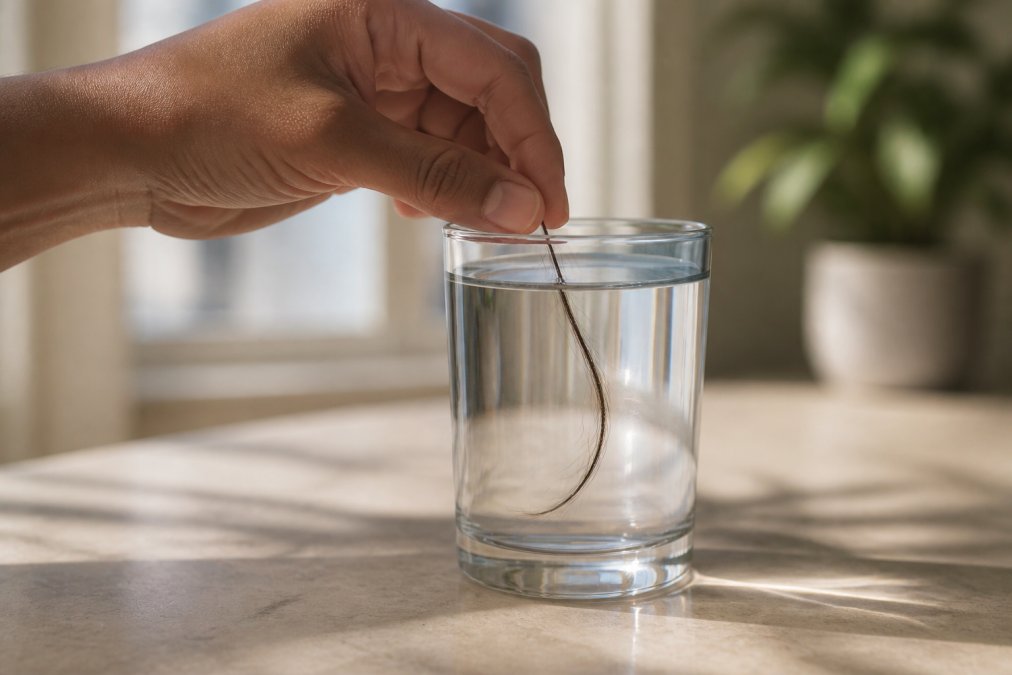
Hair porosity determines how well your hair absorbs and retains moisture. High-porosity hair absorbs water quickly but doesn't hold it well, leading to frizz and dryness. Low-porosity hair resists moisture absorption and can feel heavy or waxy. Medium-porosity hair is the sweet spot.
Take a few clean strands of hair from your brush. Fill a glass with room-temperature water and drop the hair in. If the hair sinks immediately, you have high-porosity hair and need protein-rich products to seal the cuticles. If the hair floats for several minutes before sinking, you have medium-porosity hair and respond well to balanced formulations. If the hair floats for 10+ minutes or doesn't sink at all, you have low-porosity hair and need lightweight humectants and heat to open the cuticles.
Assessing Scalp Microbiome and pH Balance
Hair and scalp are naturally acidic, with a pH around 4.5 to 5.5. This acidic environment keeps the cuticle aligned and the scalp microbiome balanced. Products with a pH above 7 disrupt this balance, causing the cuticle to raise and the scalp to overproduce sebum.
Most drugstore shampoos have a pH between 7 and 9, which is why your hair feels stripped after washing and your scalp becomes oily within a day. Quality hair care products maintain a pH-balanced formulation, typically between 4.5 and 6.5.
The scalp microbiome is the ecosystem of bacteria and fungi living on your scalp. When balanced, your scalp stays healthy and produces the right amount of sebum. Harsh products, frequent washing, and hot water disrupt the microbiome, triggering the scalp to overproduce oil as a defense mechanism. Switching to pH-balanced, gentle products often allows the scalp to rebalance within 2-3 weeks, extending the time between washes.
Best Hair Care Products for Growth: Quality Markers
High-quality hair care products designed to support hair growth share specific markers that separate them from marketing-driven alternatives.
The first marker is the presence of amino acids and hydrolyzed proteins. Hair is made of keratin, a protein composed of amino acids. When you apply hydrolyzed proteins topically, they penetrate the hair shaft and strengthen it from within, reducing breakage. Products with collagen, silk protein, or keratin peptides early in the ingredient list are actually supporting hair strength.
The second marker is the inclusion of scalp-supporting ingredients. Hair growth happens at the follicle, which is rooted in the scalp. Look for botanical extracts like rosemary, saw palmetto, or ginseng. Green Vitality USA offers products like the Hair Growth Vitamins containing biotin and saw palmetto, which work from inside the body to support hair strength and follicle health.
The third marker is the absence of ingredients that damage hair. A product can't claim to support growth while using sulfates that damage the cuticle or silicones that create buildup. Quality hair growth products are sulfate-free and silicone-free.
Ingredient transparency is the fourth marker. Quality brands list their ingredients clearly and explain what each ingredient does. The Hair Treatment Serum from Green Vitality USA exemplifies these markers: it contains argan, macadamia, and avocado oils for emollient support; vitamins A, E, and Pro B5 for antioxidant and conditioning benefits; and no sulfates or silicones.
Signs of Damaged vs. Healthy Hair
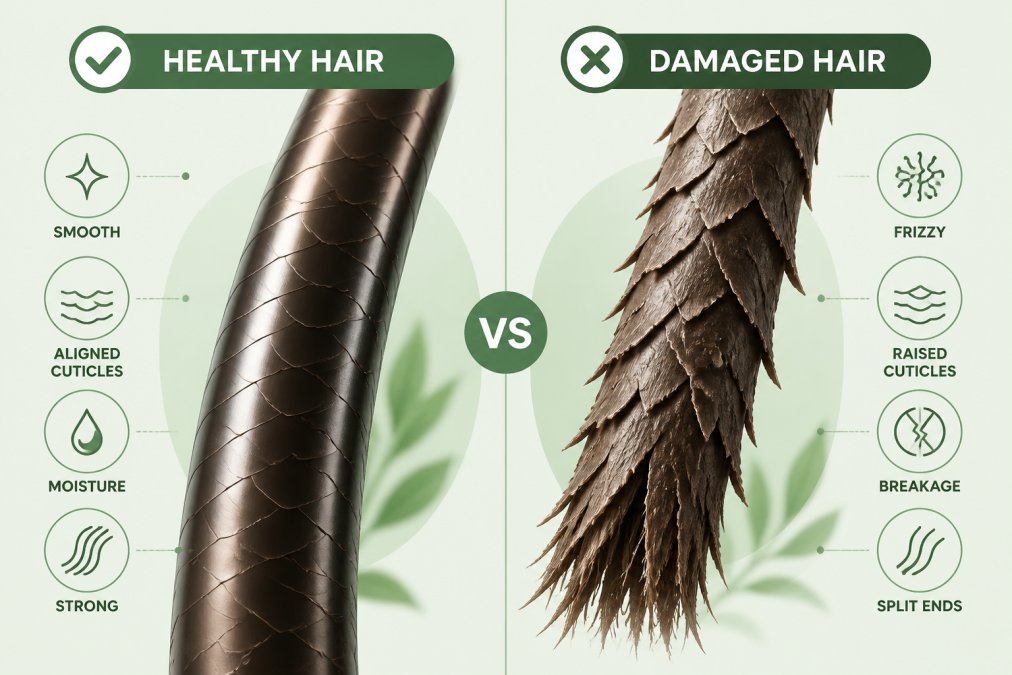
Healthy hair has aligned cuticles that reflect light evenly, creating shine. When you run your fingers down a strand of healthy hair, it feels smooth. The hair is elastic, stretches slightly when wet, and returns to its original length when released. Healthy hair doesn't break easily; you might lose 50-100 strands per day naturally, but they come out at the root, not snapping midway down the shaft.
Damaged hair has raised or missing cuticles, which scatters light and makes hair look dull. When you run your fingers down damaged hair, it feels rough or sticky. The hair lacks elasticity and snaps when stretched. You'll notice breakage throughout the length of your hair, not just at the ends. Split ends are visible, where the hair shaft has literally split into two or more strands.
The most common causes of damage are heat styling without protection, chemical processing, excessive brushing when wet, and using harsh shampoos. Recovery from damage takes time. You can't repair a split end, you have to cut it off. What you can do is stop causing new damage and support healthy growth of new hair. Within 6-8 weeks of consistent care using sulfate-free shampoos, protein-rich conditioners, and heat protectants, you'll see new healthy growth at the roots.
Budget-Conscious Quality Identification
You don't need to spend $50 per bottle to get high-quality hair care. The most expensive component of hair care is marketing. Luxury brands spend heavily on packaging, influencer partnerships, and advertising. A $45 shampoo might have nearly identical ingredients to a $12 shampoo.
Ingredient density is the first budget consideration. A product with beneficial actives in the first five ingredients is more concentrated than a product with water as the first ingredient. Concentrated products deliver more value per ounce because you need less product per wash.
Drugstore brands have improved significantly. Many now offer sulfate-free, paraben-free formulations at a fraction of luxury brand prices. Green Vitality USA curates products at accessible price points, the Hair Treatment Serum costs $8.12, delivering argan, macadamia, and avocado oils plus vitamins without the luxury markup.
Focus on non-negotiables: sulfate-free cleansing, protein-moisture balance for your porosity type, and pH-balanced formulation. A simple, well-formulated sulfate-free shampoo and matching conditioner outperforms an expensive multi-step system with harsh surfactants.
Common Mistakes When Evaluating Hair Products
The first mistake is buying based on front-of-bottle claims without reading the ingredient list. Marketing language like "moisturizing," "strengthening," or "growth-boosting" doesn't tell you what's actually in the product. The ingredient list is the only honest part of the packaging.
The second mistake is switching products too frequently. Hair needs time to adjust to a new routine. When you switch from a harsh shampoo to a gentle, sulfate-free formula, your scalp will overproduce oil for the first 1-2 weeks as it rebalances. Commit to a new routine for at least 3-4 weeks before evaluating whether it's working.
The third mistake is not matching products to your hair porosity. A lightweight, humectant-heavy product designed for low-porosity hair will make high-porosity hair feel dry and frizzy. Understanding your porosity type before buying prevents wasting money on products that won't work for you.
The fourth mistake is assuming that more expensive means better quality. A $60 shampoo isn't necessarily higher quality than a $12 shampoo if both are sulfate-free and properly formulated for your hair type.
The fifth mistake is ignoring scalp health. You can buy the best hair conditioner in the world, but if your scalp is irritated or imbalanced, your hair won't grow or look healthy. A quality routine prioritizes scalp health through pH-balanced products and ingredients that support the scalp microbiome.
| Common Mistake | Why It Happens | How to Avoid It |
|---|---|---|
| Buying based on marketing claims | Front-of-bottle language is designed to appeal emotionally | Read the ingredient list first; ignore the claims |
| Switching products too quickly | Expecting immediate results | Commit to a routine for 3-4 weeks minimum |
| Wrong products for your porosity | Not understanding hair type | Perform a porosity test before buying |
| Overspending on luxury brands | Assuming price equals quality | Compare ingredient lists and price per ounce |
| Neglecting scalp health | Focusing only on hair shaft | Use pH-balanced products and support microbiome |
Identifying high quality hair care comes down to understanding your hair's specific needs and learning to read past marketing claims to evaluate actual formulations. Start with the fundamentals: determine your hair type and porosity, understand what your scalp needs, and learn to decode ingredient lists.
When you're ready to upgrade your routine, Green Vitality USA offers curated products designed with these principles in mind. Our Hair Treatment Serum, Hair Growth Vitamins, and other formulations are selected for genuine quality at accessible prices. Shop now and experience the difference that truly high-quality hair care makes.
Frequently Asked Questions
How can I tell if hair care products are high quality without expensive testing?
Start by reading the ingredient list on the label. Quality products list active ingredients first and avoid silicones, sulfates, and parabens that strip moisture. Check for hydrolyzed proteins, humectants like glycerin, and natural oils. Look for brands with dermatologically tested certification. Perform a simple porosity test at home by placing a clean hair strand in water, quality products help hair retain moisture, improving elasticity and reducing breakage over time.
What does sulfate-free vs paraben-free hair care actually mean for my hair?
Sulfates are harsh surfactants that strip natural oils and can damage the lipid layer protecting your hair cuticle. Paraben-free products avoid synthetic preservatives that some people find irritating. Neither alone guarantees quality, a sulfate-free product with silicones can still cause buildup. The best approach is to identify high quality hair care that combines both: sulfate-free cleansing plus paraben-free preservation, alongside beneficial ingredients like amino acids and emollients that maintain cuticle alignment and moisture retention.
Are expensive hair care products always better than budget options?
No. Price doesn't always reflect quality. Many budget-friendly options contain the same beneficial ingredients as premium brands, hydrolyzed proteins, humectants, and natural oils. The difference often lies in packaging, branding, and ingredient concentration rather than efficacy. Read labels carefully: a $15 product with clean ingredients and proper pH balance can outperform a $50 product loaded with synthetic fragrances and fillers. Focus on ingredient transparency and what your specific hair type needs, not the price tag.
How do I know if a product will work for my hair before buying?
Identify your hair type and porosity first, this determines which products will actually benefit you. Match products to your needs: low-porosity hair needs lightweight humectants; high-porosity hair needs protein-rich formulas and emollients. Read reviews from people with similar hair texture. Check for ingredient interactions: combining protein-heavy products with silicone-based ones can cause buildup. Many quality brands like those available through Green Vitality USA offer affordable options to test, reducing financial risk while you learn what works for your scalp health and hair elasticity.
This article was written using GrandRanker