 ultimate-guide
How to Choose Natural Hair Products: 2026 Guide
Table of Contents
- What You'll Need Before You Shop
- Start With a Natural Hair Porosity Test
- Ingredients to Avoid in Hair Products
- Match Ingredients to Your Curl Pattern and Texture
- Best Hair Care Products for Growth (and What Growth Actually Means)
- How to Read a Natural Hair Product Label in 60 Seconds
- Common Mistakes to Avoid When Choosing Natural Hair Products
- Conclusion
- Frequently Asked Questions
Last Updated: September 27, 2026
What You'll Need Before You Shop
Choosing natural hair products starts with knowing your own hair before you reach the shelf. This guide from Green Vitality USA covers the porosity test, the label terms that matter, and the ingredients worth avoiding.
The natural hair care market has grown fast, and labels have become harder to trust.
- A spray bottle of plain water
- A wide-tooth comb or your fingers
- A clean, dry strand of shed hair (from your brush or pillow)
- A glass of room-temperature water
Start With a Natural Hair Porosity Test
A natural hair porosity test tells you how well your hair absorbs and retains moisture, and it's the foundation for every product decision that follows. Get this wrong and you'll keep buying conditioners that sit on top of your strands instead of soaking in.
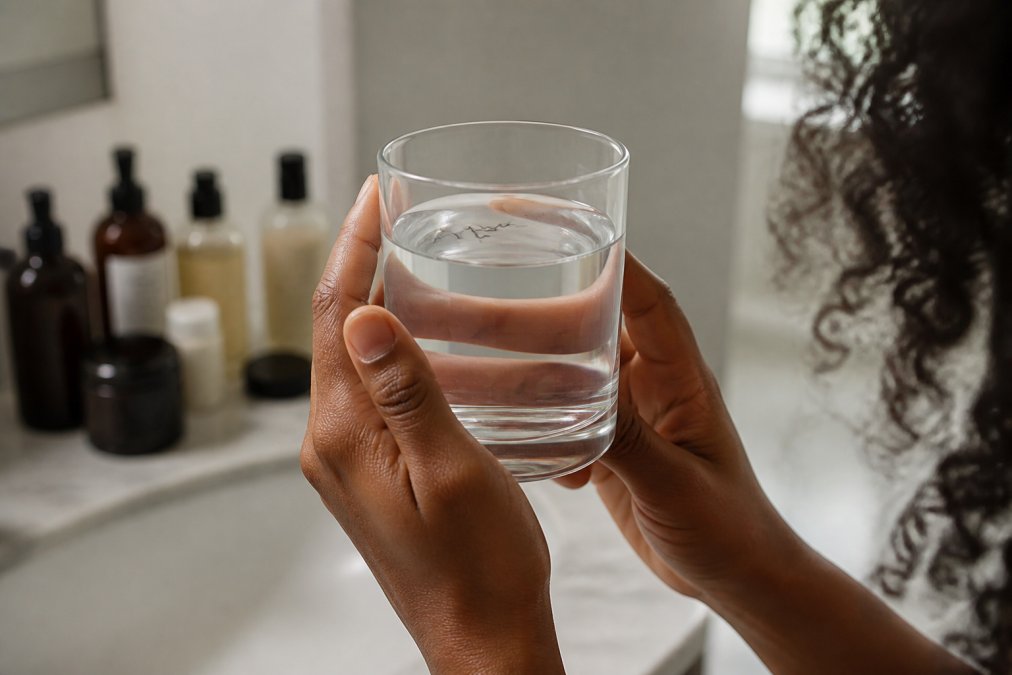
The Float Test and What It Actually Tells You
The float test is the simplest way to check porosity at home. Drop a clean strand of shed hair into a glass of room-temperature water and watch it for two to four minutes.
- Strand sinks quickly: high porosity. Your cuticle is raised, so moisture escapes fast.
- Strand floats near the top: low porosity. Your cuticle is tightly closed, so products sit on the surface.
- Strand sinks slowly, somewhere in the middle: normal porosity. Your cuticle is balanced.
Ingredients to Avoid in Hair Products
The three ingredient families worth scrutinizing are sulfates, parabens, and silicones. None is poison, the issue is what they do to textured, moisture-hungry hair over time.
Sulfates, Parabens, and Silicones: What the Label Really Says
Sulfates are the detergents that create lather. They strip natural oils along with dirt, which leaves curly and coily hair feeling straw-dry. Look for sodium lauryl sulfate and sodium laureth sulfate on the ingredient list.
Match Ingredients to Your Curl Pattern and Texture
Ingredient selection should follow your curl pattern, strand thickness, and porosity, not a trend. A product that transforms a loose wave can weigh down fine coils, and a mist that works on 2C hair will vanish on 4C.
How Humectants, Emollients, and Occlusives Actually Work
Humectants, glycerin, honey, sorbitol, panthenol, aloe vera, pull moisture from the air into the hair shaft. On low-porosity 3A hair, that moisture sits on the surface and can leave a sticky film in dry air. On high-porosity 4C hair, humectants draw moisture in, but in arid conditions they can pull water out of the hair, which is why glycerin-heavy products backfire in low humidity.
Matching by Porosity and Pattern
| Hair Profile | Humectant Role | Emollient Role | Occlusive Role | Protein Role |
|---|---|---|---|---|
| Low porosity, 3A-3B | Light, in humid air only | Lightweight oils (jojoba, grapeseed) | Avoid or use sparingly | Rarely needed; can cause stiffness |
| Normal porosity, 3C-4A | Moderate, year-round | Shea, mango, avocado | Light sealant at ends | Monthly, light hydrolyzed protein |
| High porosity, 4B-4C | Heavy, paired with occlusive | Rich butters and creams | Essential, castor, beeswax | Every 2-4 weeks, hydrolyzed protein |
A common pattern: someone with 4C high-porosity hair buys a glycerin-heavy leave-in, applies it in a dry winter climate, and ends up drier two hours later because the humectant pulled water out of the strand. Pairing it with an occlusive layer on top, or switching to a shea-butter-based cream, usually fixes it.
Why "One Product for All Hair Types" Rarely Works
A formula built for 4C hair, heavy butters, occlusives, strong protein, will suffocate fine 3A waves, while a 3A formula will evaporate off 4C coils within hours. That's why the same product gets five-star and one-star reviews from people with the same curl pattern but different porosity.
Best Hair Care Products for Growth (and What Growth Actually Means)
No product makes hair grow faster than your genetics allow. Well-formulated products protect the hair you have so it retains length instead of breaking off at the ends.
Only Supports Self Pickup With Waybill →
How to Read a Natural Hair Product Label in 60 Seconds
You can evaluate most bottles in under a minute by scanning the first five ingredients, which are listed in order of concentration. But first you need to know what the front of the bottle is legally allowed to claim, the gap between "natural" marketing and "natural" formulation is where shoppers get burned.
What "Natural," "Organic," and "Naturally Derived" Actually Mean
The FDA's guidance on cosmetic labeling makes clear that cosmetic claims must be truthful and not misleading, but there is no official government definition of the word "natural" for personal care products. That means a brand can print "natural" on a bottle containing synthetic preservatives, sulfates, and petroleum-derived silicones as long as the overall impression isn't deceptive. The word is marketing, not a standard.
The 60-Second Label Scan
Run this sequence in order:
- Check the first five ingredients. Water is usually first, which is normal. If a humectant, emollient, or occlusive you want appears in the top five, the product is built around it; after the fragrance, it's a token amount.
- Scan for sulfates, parabens, and non-soluble silicones. Look for sodium lauryl sulfate, sodium laureth sulfate, methylparaben, propylparaben, dimethicone, and cyclopentasiloxane. Water-soluble silicones like PEG-dimethicone rinse out; non-soluble ones build up.
- Identify one humectant, one emollient, or one occlusive that fits your porosity. Glycerin, honey, and aloe are humectants. Shea butter, jojoba, and cetyl alcohol are emollients. Castor oil and beeswax are occlusives.
- Look for fragrance near the top. "Fragrance" or "parfum" in the first five ingredients signals a heavily scented formula, and fragrance is a common irritant for sensitive scalps. If you react easily, look for fragrance-free or essential-oil-scented options.
- Check the preservative system. Water-based products need preservatives to prevent bacterial and mold growth. "Paraben-free" usually means phenoxyethanol, sodium benzoate, or potassium sorbate instead. A water-based product with no preservative listed is a red flag.
- Confirm the product matches your curl pattern and thickness. A cream built for 4C coils will weigh down 3A waves. A mist built for 2C hair will disappear on 4B hair.
A Note on pH and Why It's Buried on the Label
Hair's natural pH sits between 4.5 and 5.5. Shampoos far above that range, many traditional formulas run 6 to 8, lift the cuticle to clean it, which is why hair feels rough after a high-pH wash. Conditioners are formulated lower, around 3.5 to 4.5, to close the cuticle back down. If pH isn't listed, ingredient order still tells you a lot: citric or lactic acid near the top signals an acidic formula, while sodium hydroxide or soap-based surfactants signal an alkaline one.
Common Mistakes to Avoid When Choosing Natural Hair Products
The most common mistakes come from buying based on hype rather than your hair's needs.
Conclusion
Getting your natural hair products right comes down to one habit: matching the formula to your porosity, texture, and real-world results, not the loudest claim on the shelf. That's the difference between a routine that works and a shelf of half-used bottles.
Frequently Asked Questions
How do I figure out what hair products I need?
Start with two tests: a natural hair porosity test and a texture check. If a strand of your hair sinks in a glass of water, you have high porosity and need heavier sealants like shea butter or castor oil. If it floats, you have low porosity and should stick to lightweight humectants and avoid heavy butters that sit on top of the cuticle. Then match your curl pattern: tighter coils need creamier leave-ins, looser waves do better with milky sprays.
What ingredients should I avoid when buying hair products?
Check for sulfates like sodium lauryl sulfate, which strip natural oils and leave hair feeling straw-like. Parabens (methylparaben, propylparaben) are preservatives some shoppers prefer to skip. Non-water-soluble silicones such as dimethicone build up on the cuticle and block moisture from entering. If you follow the curly girl method, avoid these three categories entirely. Otherwise, sulfates are fine for a monthly clarifying wash to remove buildup.
Are natural hair products better for hair growth?
No product grows hair directly. Hair grows from the follicle at roughly half an inch per month regardless of what you apply. What natural products do is reduce breakage so you retain length. Rosemary oil, batana oil, and coconut oil-based shampoos support scalp health by reducing inflammation and improving moisture retention. Fewer broken ends mean your hair gets longer over time, which is why the best hair care products for growth focus on scalp care and gentle cleansing.
How do I build a natural hair care routine for beginners?
Keep it to four steps: cleanse, condition, moisturize, seal. Use a sulfate-free shampoo once a week, follow with a deep conditioner for 15 to 20 minutes, apply a leave-in conditioner to damp hair, then seal with a light oil. Add a protein treatment every four to six weeks if your hair feels mushy or stretchy. Skip co-washing until you know your porosity, because it can cause buildup on low porosity hair.