 listicle
Best Natural Skincare for Sensitive Skin: 2026 Guide
Table of Contents
- What Makes Sensitive Skin React (and Why Natural Formulas Help)
- Ingredients to Avoid for Sensitive Skin
- Best Natural Skincare for Sensitive Skin: Top Picks Compared
- Quick Comparison Table
- 1. Osmia Purely Simple Face Cream, Best Lightweight Moisturizer
- 2. Bee You Organics Organic Face Moisturizer, Best Fragrance-Free, Waterless Formula
- 3. 100% PURE Rose Water Gentle Cleanser, Best Budget-Friendly Cleanser
- 4. KORA Organics Active Algae Calming Cleansing Balm, Best for Makeup Removal
- 5. Schaf Serum, Best Multi-Active Serum for Reactive Skin
- 6. Pai Skincare Avocado & Jojoba Hydrating Day Cream, Best for Dry, Sensitive Skin
- 7. LilyAna Naturals Eye Cream, Best Affordable Eye Treatment
- 8. Badger Clear Zinc Sunscreen SPF 30, Best Mineral Sunscreen
- Natural Skincare Routine for Sensitive Skin: Step by Step
- How to Patch Test New Products (and Why It Matters)
- How to Transition to Natural Skincare Without Flare-Ups
- Which Natural Skincare Pick Is Right for You?
- Conclusion
Last Updated: August 14, 2026
Finding the best natural skincare for sensitive skin is harder than it looks. The clean beauty market is flooded with products claiming to be gentle, yet many still contain botanical extracts, essential oils, or pH-disrupting agents that trigger reactions. Below, you'll find eight rigorously selected picks, a step-by-step natural skincare routine for sensitive skin, and a practical guide to making the switch without flare-ups.
Quick Picks:
- Best Overall Moisturizer: Osmia Purely Simple Face Cream, lightweight, organic, formulated for reactive skin
- Best Fragrance-Free Formula: Bee You Organics Organic Face Moisturizer, waterless, essential oil-free
- Best Budget Cleanser: 100% PURE Rose Water Gentle Cleanser, calming, non-stripping, affordable
- Best Mineral Sunscreen: Badger Clear Zinc SPF 30, certified organic, broad-spectrum, reef-safe
What Makes Sensitive Skin React (and Why Natural Formulas Help)
Sensitive skin occurs when the skin barrier is compromised, allowing irritants to penetrate easily and trigger inflammation, redness, or stinging. The skin barrier, composed of lipids, ceramides, and proteins, regulates water loss and keeps environmental aggressors out.
Natural formulas help by excluding synthetic compounds most associated with barrier disruption: artificial fragrances, sulfate-based surfactants, and petroleum-derived occlusives. Plant-derived ingredients often carry calming properties and work closer to the skin's own chemistry. However, "natural" is not automatically synonymous with "safe."
Common Triggers: Fragrance, Sulfates, and pH Imbalance
Fragrance is the single most common cause of contact dermatitis in skincare, whether synthetic or natural. Essential oils, while plant-derived, contain volatile compounds that can sensitize reactive skin. Sulfates, especially sodium lauryl sulfate, strip natural oils and disrupt the skin microbiome. pH imbalance is equally problematic: skin functions optimally at 4.5-5.5, and products outside that range force the skin to work harder to rebalance, increasing sensitivity over time.
Check for synthetic fragrance-free AND essential oil-free labeling, choose sulfate-free cleansers, and prioritize pH-balanced formulations.
Environmental Impact on Sensitivity
Environmental stressors, pollution, hard water, UV exposure, and low humidity, directly compromise the skin barrier. According to American Academy of Dermatology guidance on environmental skin triggers, airborne particulate matter triggers inflammatory pathways, and hard water leaves mineral deposits that disrupt the skin's acid mantle.
If your skin reacts more in winter or after moving, the product may not be the problem. Adjust your routine seasonally and support the barrier with ceramide-supporting and occlusive ingredients during high-stress environmental periods.
Ingredients to Avoid for Sensitive Skin
Avoid these specifically:
- Sodium lauryl sulfate (SLS) and sodium laureth sulfate (SLES): Aggressive surfactants that strip the skin barrier
- Synthetic fragrances: Listed as "fragrance" or "parfum"; contain dozens of undisclosed compounds
- Parabens: Preservatives linked to skin sensitization in reactive skin
- Denatured alcohol (SD alcohol, alcohol denat.): Dries and disrupts the barrier with repeated use
- High-concentration AHAs/BHAs: Glycolic acid above 5-8% and salicylic acid above 1-2% cause significant irritation on reactive skin
- Formaldehyde-releasing preservatives: DMDM hydantoin, imidazolidinyl urea, common sensitizers
- Artificial colorants: No functional benefit; add unnecessary sensitization risk
The National Eczema Association's ingredient guide for sensitive skin provides a detailed reference for checking product labels.
Ingredient Interaction Guide: What Not to Layer
Individual ingredients can be safe alone but problematic when layered.
| Combination | Why It's Problematic | Safer Alternative |
|---|---|---|
| Vitamin C + Niacinamide (high %) | Can cause flushing in sensitive skin | Use niacinamide alone or separate AM/PM |
| Retinol + AHA/BHA | Stacks exfoliation, damages barrier | Alternate nights; never same application |
| Essential oils + active acids | Amplifies penetration of irritants | Avoid both in one routine |
| Bakuchiol + strong humectants | Generally fine, but watch for occlusion | Patch test the combination |
| Multiple botanical extracts | Unpredictable cross-sensitization | Introduce one new ingredient at a time |
Keep your routine to five ingredients or fewer until you know your triggers.
Best Natural Skincare for Sensitive Skin: Top Picks Compared
The eight products below represent the best natural skincare for sensitive skin across every routine step. Each was selected based on ingredient transparency, formulation philosophy, and suitability for reactive skin.
Quick Comparison Table
| Product | Best For | Key Claim | Fragrance-Free | Price | | --- | --- | --- | --- | | Osmia Purely Simple Face Cream | Lightweight daily moisture | Organic jojoba, aloe base | Low essential oil concentration | $62 | | Bee You Organics Face Moisturizer | Barrier repair, redness | Waterless, 100% EO-free | Yes | $28 (travel) | | 100% PURE Rose Water Cleanser | Budget-friendly cleansing | Chamomile, aloe, rose hydrosol | Yes | $30 | | KORA Organics Cleansing Balm | Makeup removal | Certified organic balm | Yes | $48 | | Schaf Serum | Multi-active treatment | Bakuchiol, peptides, niacinamide | Yes | $75 | | Pai Avocado & Jojoba Day Cream | Dry, sensitive skin | Vitamins A, D, E from avocado | Yes | $60 | | LilyAna Naturals Eye Cream | Eye area concerns | Paraben-free, no artificial color | Yes | $22.99 | | Badger Clear Zinc SPF 30 | Sun protection | 22.5% zinc oxide, certified organic | Yes | $18 |
1. Osmia Purely Simple Face Cream, Best Lightweight Moisturizer
Osmia's Purely Simple Face Cream uses an aloe vera base with organic jojoba, apricot kernel, sweet almond oil, and vitamin E. The formula uses only low concentrations of rose, chamomile, and neroli essential oils, making it one of the few natural moisturizers that feels complete without heavy fragrance. Best for sensitive, reactive, and normal skin types, including those managing perioral dermatitis.
2. Bee You Organics Organic Face Moisturizer, Best Fragrance-Free, Waterless Formula
Bee You Organics' moisturizer is 100% essential oil-free and fragrance-free, making it one of the safest options for genuinely reactive skin. The waterless formula means no fillers and minimal preservative load. A small amount goes a long way, and it doubles as an eye cream.
3. 100% PURE Rose Water Gentle Cleanser, Best Budget-Friendly Cleanser
At $30, this cleanser is the most accessible option on this list. Infused with chamomile, aloe, and rose hydrosol, it gently sweeps away dirt without stripping moisture. The foaming milk texture is gentle enough for twice-daily use.
4. KORA Organics Active Algae Calming Cleansing Balm, Best for Makeup Removal
Most natural cleansers struggle with full makeup removal. The KORA Organics balm melts away makeup and impurities while actively soothing sensitive skin. Use it as the first step in a double-cleanse routine, followed by a gentler milk or gel cleanser.
5. Schaf Serum, Best Multi-Active Serum for Reactive Skin
Schaf Serum combines bakuchiol, ectoine, vitamin C, peptides, niacinamide, and hyaluronic acid in a single fragrance-free, essential oil-free formula designed for overstimulated skin. Bakuchiol is a plant-derived retinol alternative that delivers similar skin-smoothing results without the irritation profile of synthetic retinoids. Ectoine is a natural extremolyte that stabilizes cell membranes under environmental stress.
6. Pai Skincare Avocado & Jojoba Hydrating Day Cream, Best for Dry, Sensitive Skin
Dry, sensitive skin needs both occlusive protection and emollient nourishment. Pai's formula supplies vitamins A, D, and E from avocado oil, while jojoba oil mirrors the skin's natural sebum for effective, non-greasy absorption.
7. LilyAna Naturals Eye Cream, Best Affordable Eye Treatment
The eye area is the most reactive zone on the face. LilyAna Naturals Eye Cream is free from parabens, artificial colors, and fragrances. At $22.99, it's the most affordable product on this list.
8. Badger Clear Zinc Sunscreen SPF 30, Best Mineral Sunscreen
Chemical sunscreens trigger reactive and sensitive skin. Badger Clear Zinc SPF 30 uses 22.5% clear zinc oxide for broad-spectrum UVA/UVB protection with no chemical UV filters. Formulated with organic sunflower oil, beeswax, and vitamin E, it's certified organic, fragrance-free, and reef-safe. According to FDA guidance on sunscreen active ingredients, zinc oxide is one of only two sunscreen active ingredients currently recognized as safe and effective under US regulations.
Natural Skincare Routine for Sensitive Skin: Step by Step
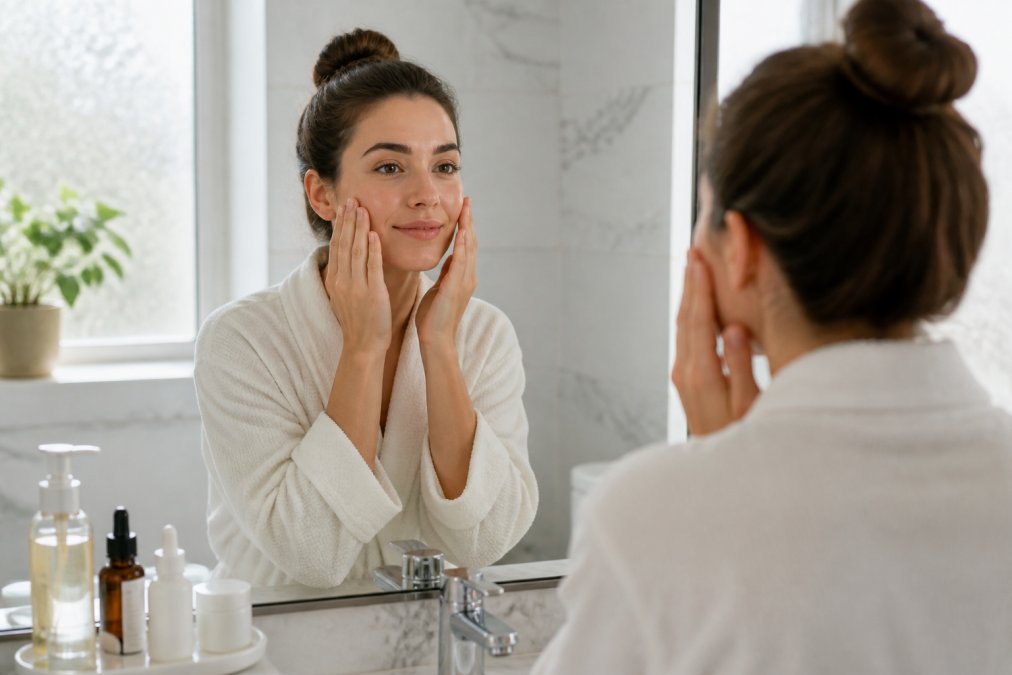
A natural skincare routine for sensitive skin works best when it's short, consistent, and built around barrier support rather than aggressive treatment.
Morning Routine
| Step | Product Type | Purpose | Time |
|---|---|---|---|
| 1. Cleanse | Gentle milk or water cleanser | Remove overnight buildup without stripping | 60 sec |
| 2. Serum | Fragrance-free, multi-active serum | Treat and repair while barrier is receptive | 30 sec + 90 sec absorption |
| 3. Moisturize | Lightweight emollient moisturizer | Seal hydration, support barrier | 30 sec |
| 4. SPF | Mineral zinc oxide sunscreen | Protect from UV and environmental stress | 30 sec |
Keep morning routines to four steps maximum. Adding toners, mists, or additional serums increases sensitization risk without proportional benefit.
Evening Routine
Evening is when barrier repair happens. Skin cell turnover peaks at night, making this the right time for richer, more occlusive products.
- First cleanse (if wearing makeup or SPF): Cleansing balm to dissolve SPF and makeup
- Second cleanse: Gentle milk cleanser to clear residue
- Treatment serum: Apply while skin is slightly damp
- Rich moisturizer or face oil: Heavier than your AM moisturizer; focus on occlusive and emollient ingredients
- Eye cream: Apply last to the orbital bone area
How to Patch Test New Products (and Why It Matters)
Patch testing is essential before introducing any new product to a sensitive skin routine. Apply a small amount to the inner forearm or behind the ear, leave it on for 24-48 hours without washing, and observe for redness, itching, or swelling.
Most reactions appear within 24 hours. For products containing potential allergens like botanical extracts, extend observation to 72 hours. If no reaction occurs, introduce the product into your routine one item at a time, not alongside other new products.
How to Transition to Natural Skincare Without Flare-Ups
The biggest mistake most people make is switching everything at once. The skin needs a gradual, controlled introduction of new products.
The recommended approach:
- Start with the product your skin touches longest: Moisturizer and SPF stay on all day. Switch these first.
- Wait two weeks before adding the next product: This gives your skin time to adjust and makes it possible to identify the cause of any reaction.
- Keep a simple log: Note what you applied, when, and any skin response.
- Don't abandon a product after one use: Initial purging or mild adjustment responses are common in the first one to two weeks.
- Avoid switching your cleanser last: Cleansers have the shortest contact time with skin and are the lowest-risk swap.
Sustainability vs. Efficacy: What to Expect When You Switch
Natural and plant-based formulas are generally more sustainable in sourcing and production, and they avoid synthetic compounds most associated with sensitization. However, some synthetic ingredients outperform their natural equivalents. Hyaluronic acid is now predominantly biofermented rather than animal-derived. Bakuchiol is a genuine plant-derived alternative to retinol with strong evidence behind it.
Where natural formulas sometimes fall short: preservative systems. Synthetic preservatives like phenoxyethanol are more effective at lower concentrations than most natural alternatives. According to Environmental Working Group's Skin Deep cosmetics database, ingredient transparency in personal care products remains inconsistent, making third-party databases a useful cross-reference when evaluating clean beauty claims.
Which Natural Skincare Pick Is Right for You?
The best natural skincare for sensitive skin depends on your primary concern, budget, and how reactive your skin currently is.
- If your skin is reactive and you've failed with "natural" products before: Start with Bee You Organics Organic Face Moisturizer and Badger Clear Zinc SPF 30. Both are essential oil-free, fragrance-free, and formulated for worst-case sensitivity.
- If you want visible results without irritation: Schaf Serum is the most comprehensive single-step treatment on this list.
- If budget is the primary constraint: LilyAna Naturals Eye Cream ($22.99) and 100% PURE Rose Water Cleanser ($30) deliver solid formulations at accessible price points.
- If your skin is dry AND sensitive: Pai Avocado & Jojoba Hydrating Day Cream is the strongest pick for sustained hydration.
- If you're removing makeup: Start your evening routine with KORA Organics Cleansing Balm before switching to a gentler second cleanser.
The Green Vitality USA platform makes it straightforward to find and order these products with a fast, user-friendly shopping experience that brings them directly to your door.
Frequently Asked Questions
What is the best natural skincare for sensitive skin?
The best natural skincare for sensitive skin prioritizes fragrance-free, paraben-free, and sulfate-free formulas with plant-derived ingredients like aloe vera, jojoba oil, and chamomile. Products with hypoallergenic, non-comedogenic certifications reduce the risk of reactions. Cleansers, moisturizers, and serums that support skin barrier repair and reduce transepidermal water loss are the most effective starting points. Always patch test before committing to a new product.
Are essential oils bad for sensitive skin?
Many essential oils are common triggers for reactive skin, even in natural formulas. Oils like citrus, peppermint, eucalyptus, and lavender contain volatile compounds that can cause redness, stinging, or contact dermatitis. If you prefer plant-based skincare, look for essential oil-free formulas that still deliver botanical benefits through gentler ingredients like cold-pressed carrier oils, botanical extracts, and ceramide-supporting actives.
How do I know if a natural product is safe for sensitive skin?
Check the ingredient list for common irritants: synthetic fragrance, alcohol denat., sulfates, and high-concentration essential oils. Look for dermatologist-tested, hypoallergenic, and non-comedogenic labels. Organic certification from bodies like the USDA adds another layer of transparency. Most importantly, patch test every new product on your inner arm for 24 to 48 hours before applying it to your face.
What ingredients should I avoid in natural skincare for sensitive skin?
Avoid synthetic fragrance (listed as 'fragrance' or 'parfum'), alcohol denat., sodium lauryl sulfate (SLS), formaldehyde-releasing preservatives, and high concentrations of essential oils. Even some 'natural' ingredients like citrus extracts and mint can irritate reactive skin. Ingredients to avoid for sensitive skin also include artificial dyes and certain preservatives like methylisothiazolinone, which is flagged by dermatologists as a frequent contact allergen.
How long does it take to transition to natural skincare without breakouts?
Most people experience a short adjustment period of two to four weeks when switching to natural skincare. During this time, the skin microbiome recalibrates and transepidermal water loss may temporarily increase. Introduce one new product at a time, spaced a week apart, so you can identify any reaction clearly. Sticking to a simple, fragrance-free routine during the transition reduces the chance of flare-ups significantly.
Sensitive skin demands more from a skincare routine, and the natural skincare category has enough noise to make the right choices genuinely difficult. Green Vitality USA brings together a curated range of high-quality, clean beauty products at cost-effective prices, with a customer-focused experience designed for people who don't have time to research every ingredient themselves. Shop Now at Green Vitality USA and find the natural skincare routine your skin has been waiting for.
This article was written using GrandRanker