 listicle
Best Natural Face Moisturizer for Reactive Skin in 2026
Table of Contents
- What Reactive Skin Actually Needs From a Moisturizer
- Soothing Ingredients for Reactive Skin: What to Look For
- Best Natural Face Moisturizer Options for Reactive Skin
- How to Patch Test New Skincare Products Safely
- Building a Skincare Routine for Reactive Skin
- Cost-Per-Ounce Comparison and Microbiome-Friendly Formulas
- Conclusion
- Frequently Asked Questions
Last Updated: September 13, 2026
What Reactive Skin Actually Needs From a Moisturizer
Reactive skin overreacts to products, weather, or stress with redness, stinging, or irritation. The best natural face moisturizer for reactive skin does two jobs: rebuilds the skin barrier and calms inflammation without adding new triggers. This guide from Green Vitality USA breaks down what works.
Most people with reactive skin are not dealing with an allergy but a compromised lipid barrier. When that barrier thins, transepidermal water loss rises, irritants penetrate more easily, and every new product feels like a gamble. A moisturizer's job is to slow that water loss and supply the missing lipids.
That reframes the search: you are not shopping for the richest cream or the longest ingredient list, but a short, boring, well-formulated one.
Soothing Ingredients for Reactive Skin: What to Look For
Soothing ingredients for reactive skin fall into four groups, and a well-built moisturizer usually combines two or three: humectants that pull water into the upper layers, emollients that soften and fill the gaps between corneocytes, occlusives that slow water loss at the surface, and anti-inflammatory botanicals that reduce visible redness. Knowing an ingredient's group tells you what it can and cannot do.
Humectants: Water In
Humectants attract and hold water. Glycerin is the most studied and cheapest, and it appears near the top of most barrier-repair formulas. Hyaluronic acid holds a large multiple of its weight in water, but its benefit is temporary and surface-level, it hydrates the upper layers without repairing the lipid barrier. Panthenol (provitamin B5) and sodium PCA are also worth scanning for. The catch: in very dry air, a humectant with no occlusive on top can pull moisture from deeper skin and lose it to the environment, which is why a hyaluronic acid face cream for deep hydration works best layered under something heavier.
Emollients and Occlusives: Water Stays
Emollients mimic the skin's own lipids and soften the surface; occlusives form a film that slows transepidermal water loss. Shea butter, jojoba, squalane, and cold-pressed oils like sunflower and oat are common plant-based emollients. Ceramides are the most overlooked, naturally present in the barrier, they help replace what irritation has stripped away, with cholesterol and fatty acids rounding out the lipid trio. If your skin feels tight and flaky rather than red, prioritize this group.
Anti-Inflammatory Botanicals: Redness Down
Botanical extracts like green tea, aloe vera, centella asiatica, heart leaf, licorice root, and colloidal oatmeal bring antioxidant and anti-inflammatory support that can reduce visible redness over time; centella asiatica in particular is associated with calming and barrier support. These are supporting players, not the main event, a botanical extract will not fix a stripped barrier on its own.
Ingredients to Avoid: Fragrance, Essential Oils, and Harsh Actives
Fragrance is the single most common trigger for reactive skin, hiding behind dozens of label names, parfum, linalool, limonene, citronellol, geraniol, and "natural fragrance" among them (PubMed). Essential oil-free and fragrance-free formulas are the safer default, even when the oils are marketed as natural. Natural does not mean non-irritating; poison ivy is natural.
Harsh actives are the second trap. Retinoids, high-percentage AHA/BHA acids, and strong vitamin C serums have their place, but not while a barrier is compromised. Pause them, repair the barrier, then reintroduce one at a time. Alcohol denat, menthol, and physical scrubs belong on the same pause list.
Look for formulas labeled non-comedogenic and hypoallergenic, and check whether the brand states dermatologist-tested and pH-balanced. Those labels are not guarantees, none of them are regulated the way drug claims are, but they signal a formulation built with sensitive skin in mind. For what cosmetic terms are actually enforceable, the FDA guidance on cosmetic labeling claims is the authoritative reference.
Best Natural Face Moisturizer Options for Reactive Skin
The best natural face moisturizer for reactive skin is built around barrier repair, not a long list of trendy actives. Green Vitality USA carries several affordable options that fit that brief, each suited to a slightly different skin type and concern.
Hyaluronic Acid Face Cream for Deep Hydration
The Moisturizing Face Cream with Hyaluronic Acid is the most straightforward pick for dry, reactive skin at $12.20 for 100ml. Hyaluronic acid pulls water into the skin, and the 100ml size suits daily use on face and neck.
Centella and Heart Leaf Creams for Barrier Repair
Centella asiatica and heart leaf are the two botanicals most associated with calming, and both appear here. The Hoygi Centella Repair Moisturizer targets barrier repair and firmness at $12.49, while the Hoygi Heart Leaf Moisturizing and Soothing Cream relieves dryness and restores elasticity, also $12.49.
Shea Butter and Turmeric Formulas for Daily Gentle Care
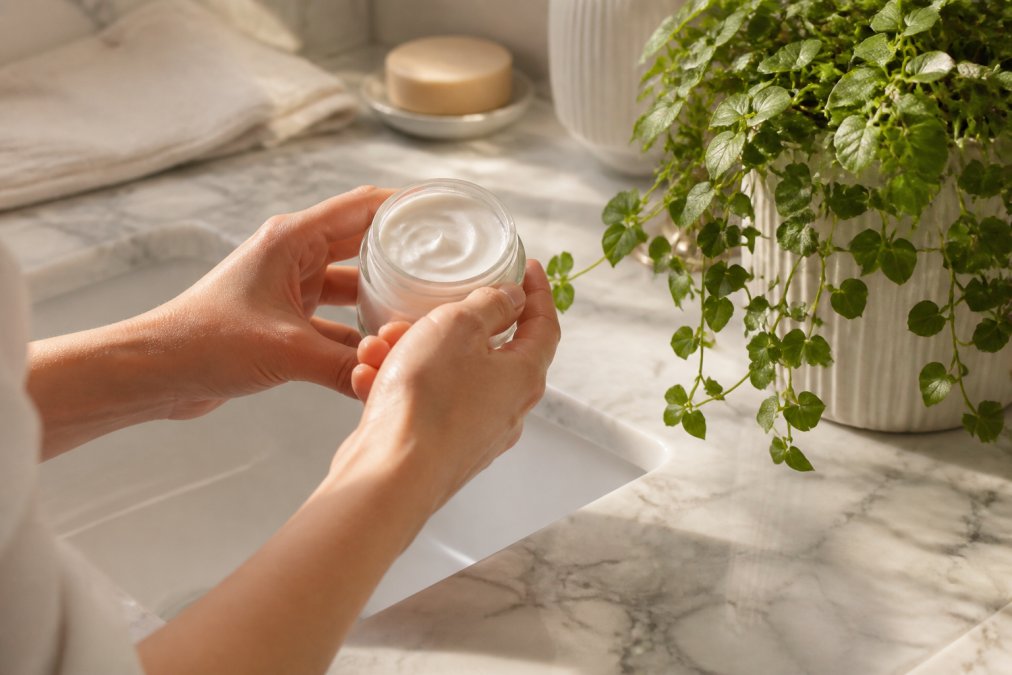
For everyday maintenance, shea butter and turmeric pair well. The OceAura Shea Butter Moisturizer uses shea as its main emollient at $12.49, and the West Month Turmeric Moisturizing Face Cream is the lowest price in the range at $10.29.
A quick comparison of the four:
| Product | Key Ingredient | Price | Best For |
|---|---|---|---|
| Moisturizing Face Cream | Hyaluronic acid | $12.20 / 100ml | Dry, dehydrated reactive skin |
| Hoygi Centella Repair | Centella asiatica | $12.49 | Redness and barrier repair |
| Hoygi Heart Leaf | Heart leaf extract | $12.49 | Dryness and lost elasticity |
| West Month Turmeric | Turmeric | $10.29 | Daily gentle maintenance |
| OceAura Shea Butter | Shea butter | $12.49 | Emollient sealing layer |
How to Patch Test New Skincare Products Safely
Patch testing means applying a small amount of a new product to a controlled area of skin and waiting 24 to 48 hours before using it on your face. It is the only reliable way to learn whether a moisturizer will trigger a reaction before that reaction hits your whole face.
Here is the protocol that works:
- Cleanse a small area on your inner forearm or behind your ear. Keep it bare for the day.
- Apply a pea-sized amount of the product to that patch. Do not rub it in aggressively.
- Wait 24 hours. Note any redness, itching, burning, or bumps.
- Reapply to the same spot and wait another 24 hours if the first day was clear.
- Test on the jawline for one more day before committing to your full face.
- Introduce one product at a time, spaced a week apart, so you can identify the culprit if something goes wrong.
A common mistake is patch testing on the face directly because the forearm "isn't the same skin." It is not, but it is a far safer place to find out: a reaction on your forearm is an inconvenience, while one across your face is a week of your life.
Building a Skincare Routine for Reactive Skin
A skincare routine for reactive skin should have four steps and no more: a gentle cleanse, an optional soothing serum, a moisturizer, and morning sunscreen. Every extra step is another variable to test.
Morning: rinse with lukewarm water or a fragrance-free cleanser, apply moisturizer to damp skin, then sunscreen. Evening: cleanse, moisturize, stop. Resist exfoliants, essences, or treatment pads until your barrier has been stable for at least a month. When reintroducing an active, add one product every two weeks and keep the rest unchanged.
Map Your Environmental Triggers Before You Blame the Product
Most people with reactive skin assume the moisturizer is the problem. Often it is not. Before cycling through another five products, rule out the environment, because reactivity that tracks with weather, location, or season is a different problem with a different fix.
- Climate and humidity. Cold, low-humidity air strips the barrier and raises transepidermal water loss. If your skin flares every winter, the trigger is the season, not the jar. Switch to a heavier emollient or occlusive layer in the cold months and a lighter humectant-forward formula in summer.
- Pollution and particulate exposure. Urban particulate matter is associated with oxidative stress on the skin surface. If your skin is calm on weekends away and reactive on workdays in a dense area, pollution may be a contributor. Cleansing gently at night matters more than adding another serum.
- Water hardness. Hard water leaves mineral residue that can leave skin feeling tight and can worsen irritation for some people. If your skin is worse after washing and better after a trip, a shower filter or a final rinse with filtered or distilled water is a cheap test.
- Heat, sweat, and friction. Hot showers, saunas, and heavy exercise raise skin temperature and can trigger flushing. Lukewarm water and a quick post-sweat rinse reduce the load.
- Fabric and detergent. Residue on pillowcases and towels is an underrated trigger. A fragrance-free detergent and a regular wash cycle rule it out.
A simple way to test: keep your routine identical for two weeks and log flares against weather, location, and washing habits. Patterns usually show up fast. If flares track the environment, changing products will not fix them.
Post-Reaction Recovery Protocol
When a flare-up happens, calm the skin rather than hunting the culprit. Stop the new product immediately and add nothing else to test it. Revert to the blandest products you know your skin tolerates, a fragrance-free cleanser and a simple emollient moisturizer, and skip actives, exfoliants, and anything with fragrance or essential oils until the skin is calm. Rinse with lukewarm, not hot, water and avoid scrubbing. Keep the routine to cleanse and moisturize for several days. If the reaction is severe, spreading, or accompanied by swelling or blistering, see a dermatologist. Once skin has been stable about a week, patch test the suspect product on your forearm to confirm whether it was the trigger.
Microbiome-Friendly Formulations
The skin microbiome is the community of bacteria on the skin surface, and harsh surfactants, high-pH cleansers, and preservative-heavy formulas can disrupt it, one more route to sensitivity. pH-balanced formulas that avoid unnecessary fragrance and essential oils tend to be gentler on that community, though "microbiome-friendly" is not a regulated claim, so read the ingredient list rather than the marketing line. Prebiotic ingredients like oat and postbiotic ferment filtrates appear in some formulas marketed this way; the evidence is still developing, so treat them as a nice-to-have, not a requirement.
Cost-Per-Ounce Comparison and Microbiome-Friendly Formulas
Cost per ounce matters more here than most, because reactive skin often means buying several products before finding one that works. At $12.20 for 100ml, the hyaluronic acid cream works out to roughly $3.60 per fluid ounce, and the turmeric cream at $10.29 is the cheapest entry point.
For guidance on cosmetic labeling and what terms are actually regulated, the FDA guidance on cosmetic labeling claims is the authoritative reference.
Conclusion
The hard part of shopping for reactive skin is not finding a moisturizer, but finding one you can test without risking a week of redness, and without spending a fortune on trial and error.
Green Vitality USA curates affordable options that fit the barrier-repair brief, from the $12.20 hyaluronic acid cream for deep hydration to the $10.29 turmeric formula for daily gentle care. Every product ships directly to your door, the catalog is small enough to browse quickly, and prices stay low enough that patch testing a few options does not become an expensive project.
Shop now with Green Vitality USA and build a routine your skin can actually tolerate.
Frequently Asked Questions
What is the best natural moisturizer for a sensitive face?
The best natural face moisturizer for reactive skin is one that is fragrance-free, essential oil-free, and built around soothing ingredients like ceramides, shea butter, or centella. Look for formulas labeled hypoallergenic and non-comedogenic, then patch test before full use. Gentle options such as the Hoygi Centella Repair Moisturizer or the Hyaluronic Acid Face Cream hydrate without triggering redness or stinging.
What ingredients should I avoid if I have reactive skin?
Skip synthetic fragrance, essential oils like lavender and citrus, denatured alcohol, and strong exfoliating acids. These can strip the lipid barrier and trigger redness, stinging, or breakouts. Also avoid products with high concentrations of vitamin C or retinol unless introduced slowly. Instead, choose fragrance-free, pH-balanced formulas with soothing agents such as aloe vera, green tea extract, or panthenol.
How can I tell if a moisturizer is truly natural?
Check the ingredient list for recognizable plant-based emollients and botanical extracts, and look for terms like organic certification, cold-pressed oils, or clean beauty on the label. If the label lists only 'fragrance' or 'parfum' without specifying the source, it may contain synthetic irritants.
Can I use the same moisturizer for both dry and oily reactive skin?
Not always. Dry reactive skin may benefit from richer plant-based emollients like shea butter or hyaluronic acid, while oily reactive skin may need lightweight, non-comedogenic formulas that hydrate without clogging pores. Patch test to see how your skin responds.